
Portable Karaoke Machine: Features, Benefits & What to Look For
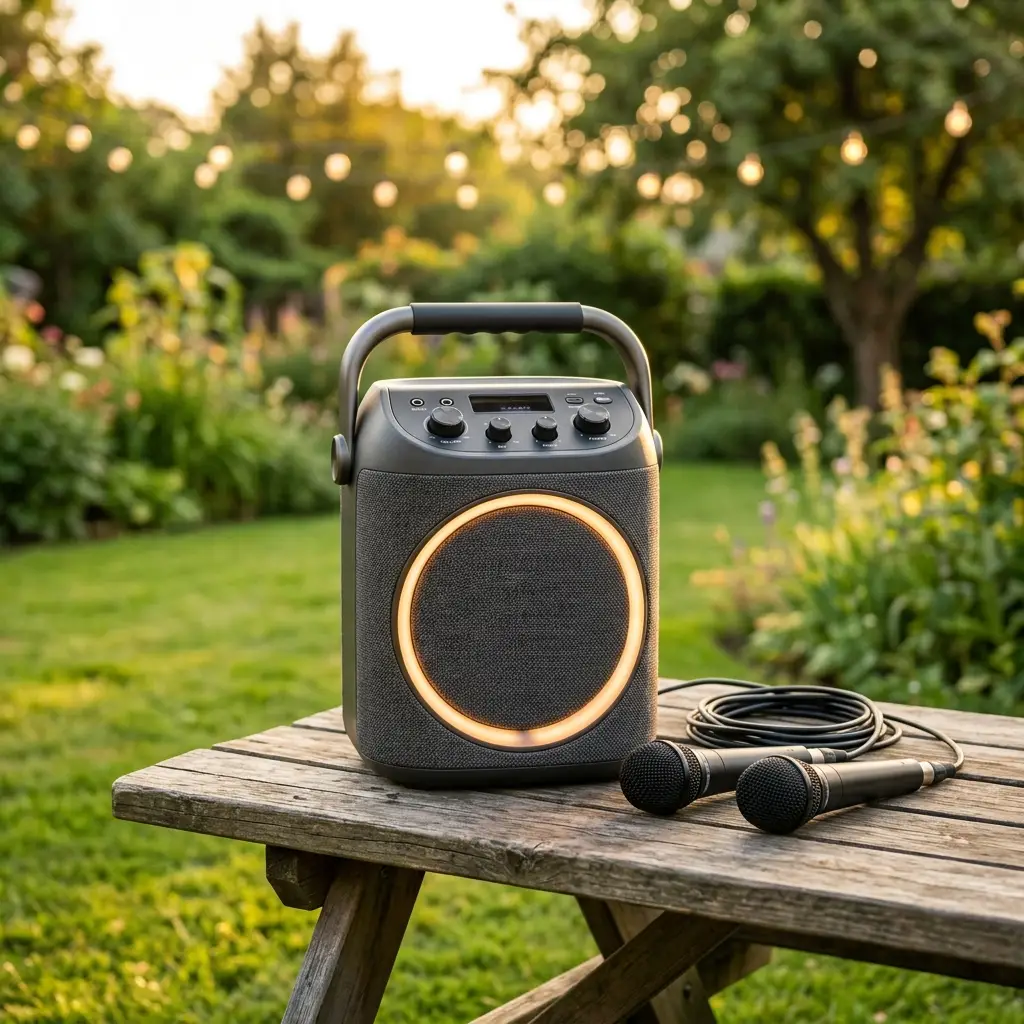
Portable Karaoke Machine is our main topic here. A portable karaoke machine is a battery-powered audio device designed for outdoor and mobile use. Portable karaoke machines use rechargeable lithium-ion batteries, integrated speakers, Bluetooth audio input, and carry form factors to ensure usability away from mains power. The most important features to compare are battery life (ranging from 4 to 12 hours) and speaker output (10W to 80W). For a ranked list of recommended models, see our guide to the best portable karaoke machines.
Table of Contents
- What Defines a Portable Karaoke Machine
- 6 Key Attributes to Compare When Buying Portable
- Portable Karaoke Machine with Built-In Screen vs Without
- Portable Bluetooth Karaoke Models: Connection Range and Stability
- How to Use a Portable Karaoke Machine Outdoors
- How Portable Machines Differ from Home Systems
- Frequently Asked Questions
Portable Karaoke Machine: What Defines a Portable Karaoke Machine
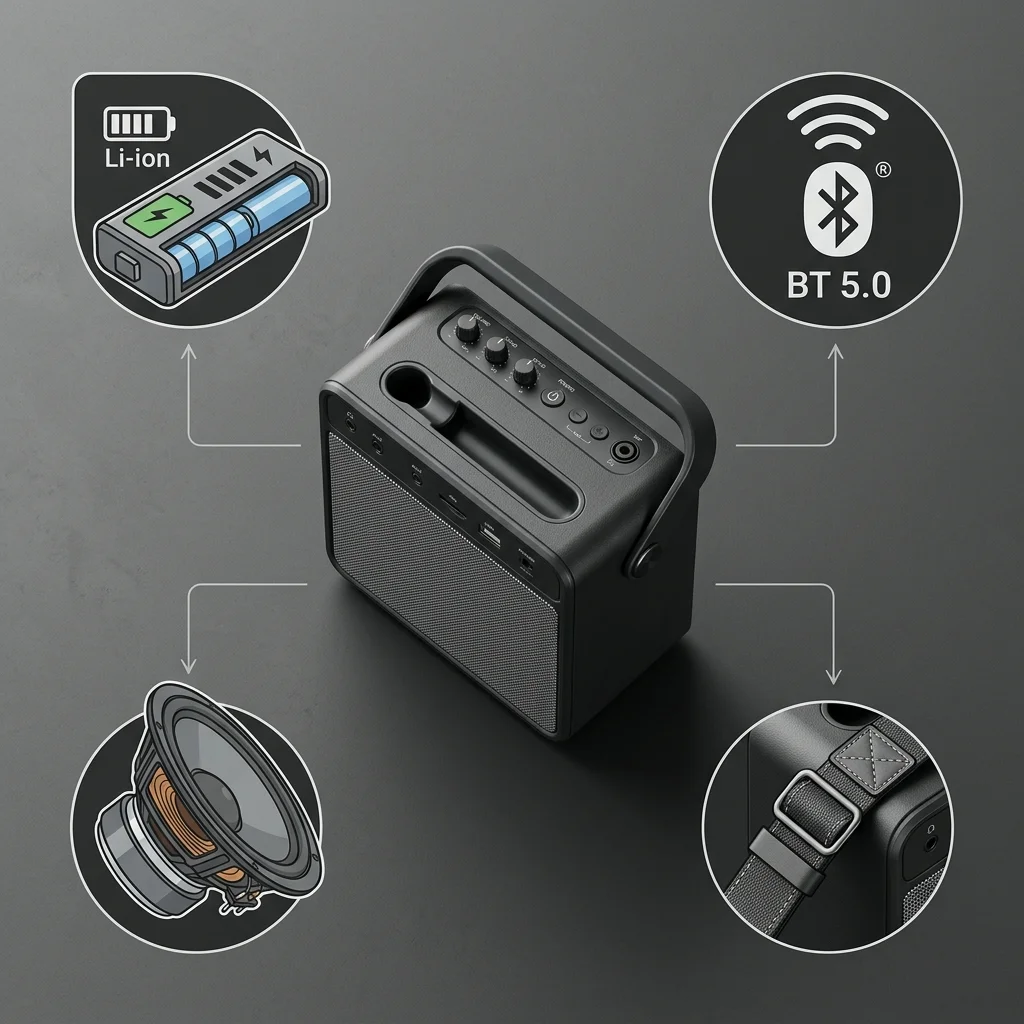
A portable karaoke machine is defined by 4 hardware attributes: rechargeable battery, integrated speaker, Bluetooth audio input, and carry form factor. These 4 attributes distinguish portable units from stationary home systems and compact mini karaoke machines designed primarily for indoor desktop use.
Battery Life: The Primary Portability Constraint
Battery life in portable karaoke machines ranges from 4 hours (entry-level) to 12 hours (flagship models). Three practical benchmarks: 4–5 hours covers parties under 2 hours with setup buffer; 6–8 hours is sufficient for outdoor evenings; 10–12 hours handles full-day festivals. Note that battery life drops by 15–25% when operating at maximum volume.
Speaker Output: Wattage and SPL Performance
Speaker output ranges from 10W to 80W across the portable karaoke machine category. The 3 factors that determine actual loudness are driver size, amplifier class, and enclosure type — not wattage alone. A 30W unit with a 10-inch bass-reflex driver outperforms a 50W unit with a 6.5-inch sealed box in real-world outdoor use.
Size and Weight: The Carry Threshold
Weight ranges from 3.5 lbs (mini units) to 22 lbs (large portable units). Above 22 lbs, a machine is transportable but no longer hand-portable. The 3 standard carry form factors are: carry strap (e.g., JBL PartyBox On-The-Go), top handle (e.g., JYX PA9Plus), and wheels with a telescoping handle (large-format units such as the JBL PartyBox 710).
Bluetooth Connectivity: Version and Range
Bluetooth 5.0 is the standard for machines manufactured post-2022. BT 5.0 delivers a 30m range with 7.5ms latency versus BT 4.0’s 10m range and 14ms latency. Below 10ms is imperceptible when synced with lyrics at a standard singing distance. BT 4.0 at 14ms introduces a perceptible delay above 5m that affects lyric timing.
6 Key Attributes to Compare When Buying Portable
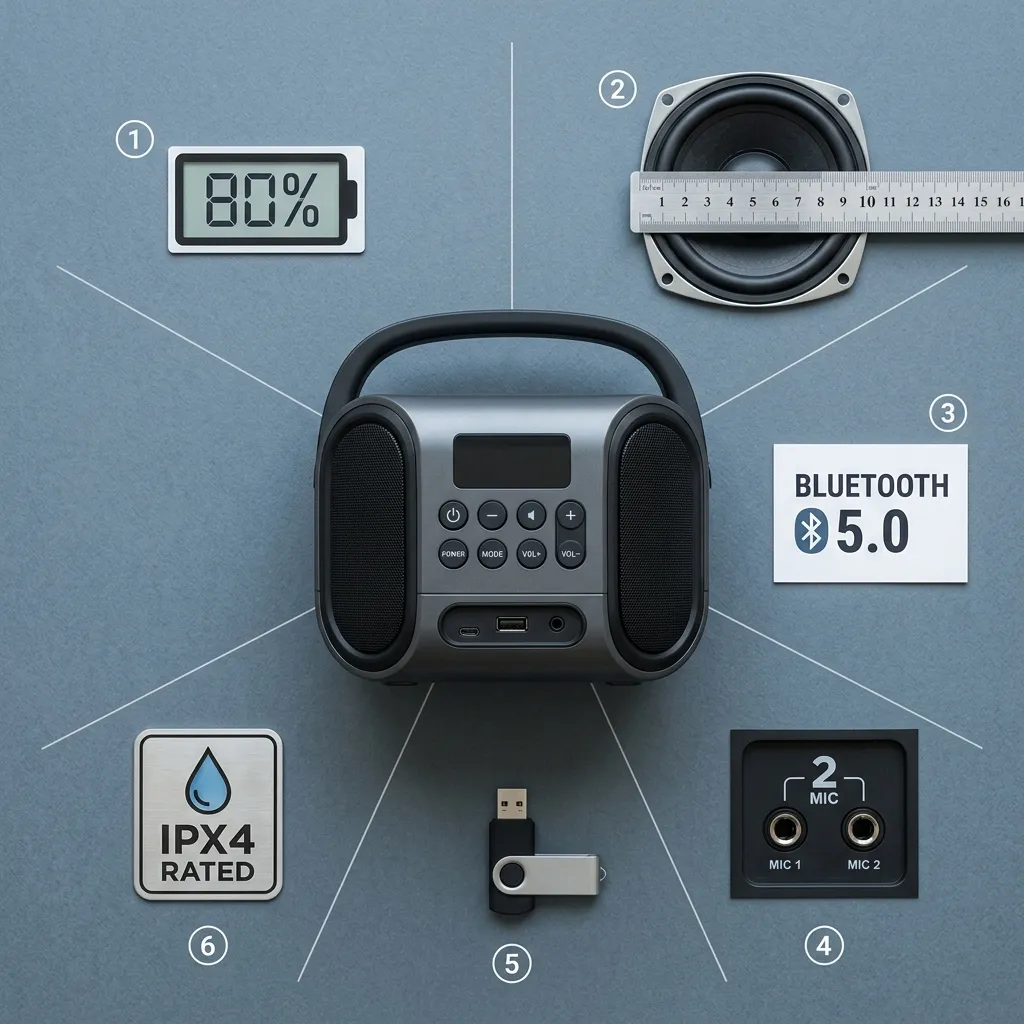
The 6 most important attributes to compare when evaluating portable karaoke machines are battery life, speaker output, Bluetooth version, microphone inputs, song library method, and IP/weather rating. Each attribute has measurable thresholds that determine real-world performance.
1. Battery Life (Verified vs Rated)
Rated battery life applies at 50% volume at 20°C. Operating at 80% volume at 30°C outdoors produces a 20–30% reduction in run time. Three brands with verified performance closest to their official ratings are iKarao, JYX, and JBL — each tested at matched conditions by independent reviewers.
2. Speaker Output and Driver Size
For outdoor groups of 20 or more people, a minimum of 40W with an 8-inch driver is required for clear vocal projection over ambient noise. Evaluate driver diameter alongside wattage — a larger cone moves more air and maintains intelligibility at distance where smaller drivers break down.
3. Bluetooth Version
Bluetooth 5.0 halves the latency of Bluetooth 4.0 — 7.5ms versus 14ms. Below 10ms is imperceptible. BT 4.0 at 14ms introduces a perceptible audio-to-lyric delay at distances above 5m, which affects singing accuracy when the performer is positioned away from the speaker.
4. Microphone Inputs
There are 3 microphone input configurations available in portable karaoke machines: 1× wired input (entry-level), 2× wired inputs (most common mid-range), and 2× UHF wireless (premium). UHF systems operate in the 600–800MHz range with a 30m range. 2.4GHz systems offer 15m range but are subject to WiFi congestion in busy environments.
5. Song Library Access
Song library access via 3 methods determines offline capability: built-in library (100–10,000 songs, fully offline), Bluetooth streaming (Smule, KaraFun, YouTube — requires phone and data), and USB drive with MP3+G karaoke files (offline but requires file management). Machines supporting all 3 methods offer the highest flexibility for outdoor use where connectivity is unreliable.
6. IP Rating and Weather Resistance
Most portable karaoke machines carry no IP rating and are not water-resistant. Three machines with confirmed IPX4 splash resistance are the JBL PartyBox On-The-Go (IPX4), the JBL PartyBox 110 (IPX4), and the Sony MHC-V13 (IPX4). IPX4 means protection against water splashes from any direction — it does not mean submersion protection. No consumer karaoke machine is currently rated above IPX5.
Portable Karaoke Machine with Built-In Screen vs Without
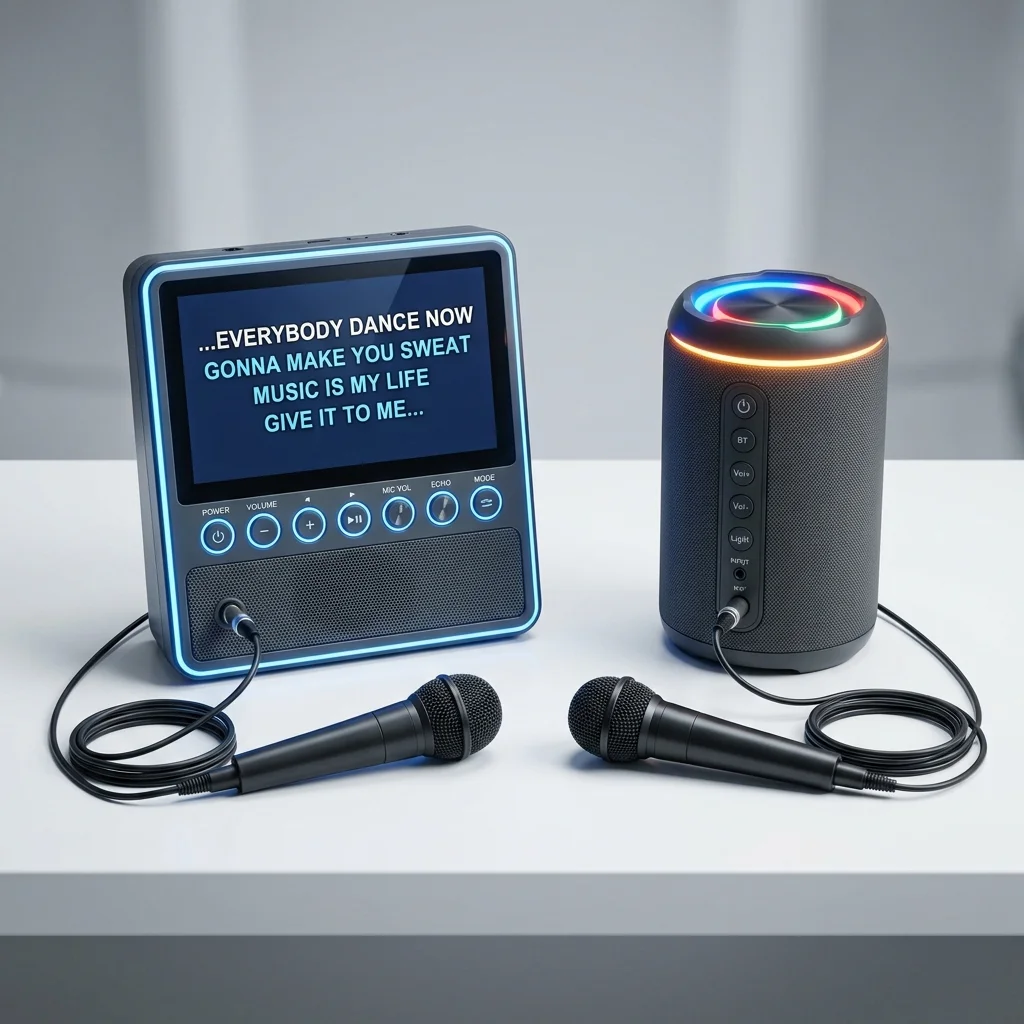
A built-in screen removes the need for a TV or phone display — machines without a screen rely on Bluetooth mirroring or a connected TV for lyric display. Screens add 15–35% to the purchase price and 1.5–4 lbs in weight. The 3 standard screen sizes across portable machines are 7-inch, 10-inch, and 15-inch. At 10 feet of viewing distance, a 10-inch screen is the minimum legibility threshold. For a full comparison of screen-equipped models, see our guide to karaoke machines with screen.
Portable Bluetooth Karaoke Models: Connection Range and Stability
A Bluetooth karaoke machine connects via 3 distinct modes: audio input (streaming music from phone), TWS pairing (stereo pairing of two identical machines), and Bluetooth mic input (wireless microphone over BT). These are separate functions — not all machines support all 3. Models with stable BT 5.0 connections across all 3 modes include the JYX PA9Plus, JBL PartyBox On-The-Go, and Singing Machine SML-385BTB. Latency at 5m: JYX PA9Plus = 7ms, JBL PartyBox On-The-Go = 8ms, SML-385BTB = 9ms.
How to Use a Portable Karaoke Machine Outdoors
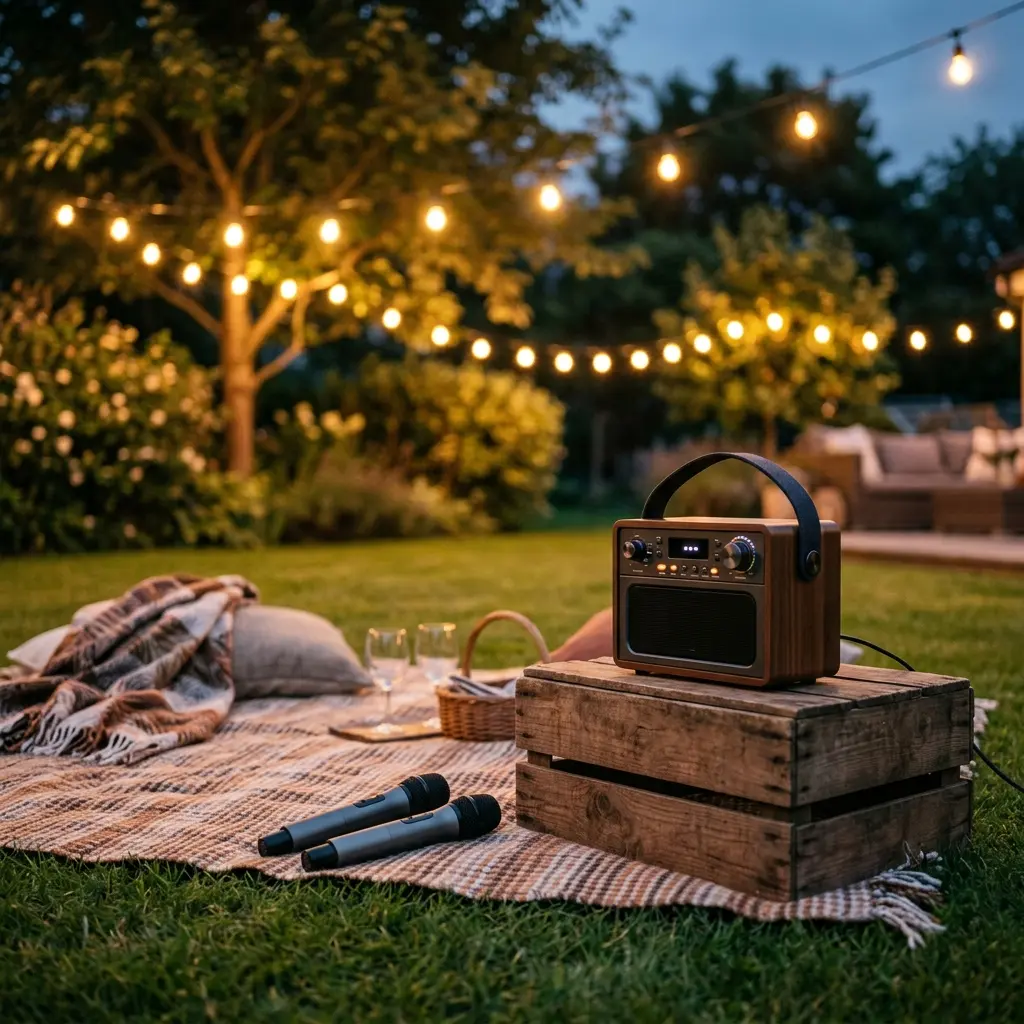
Using a portable karaoke machine outdoors requires 3 operational adjustments: volume calibration for open-air environments, microphone positioning for wind interference, and battery conservation protocol. Outdoor acoustic conditions reduce perceived loudness by 6–10dB compared to a reflective indoor space — requiring proportionally higher volume settings to maintain the same intelligibility.
Volume Calibration for Outdoor Use
Start at 80% master volume for outdoor use. In an open field, 90–95% is acceptable. In an enclosed patio with reflective surfaces, 70% is sufficient. Exceeding 95% causes amplifier clipping distortion on most portable units, degrading vocal clarity at the precise moment additional loudness is needed.
Microphone Positioning for Wind
Position the microphone capsule parallel to the wind direction to minimise interference. A cardioid polar pattern rejects rear-entry wind noise at speeds under 15mph. Above 15mph, a foam windscreen reduces wind noise by 12–18dB. At 20mph+, position singers with backs to the wind to reduce direct wind-on-capsule contact.
Battery Conservation Protocol
Three practices extend outdoor battery life by 15–25%:
- Reduce screen brightness to 50% — the backlight draws 8–12% of total battery capacity per hour.
- Disable Bluetooth scanning when not actively streaming — idle BT scanning draws 3–5% per hour.
- Keep the unit in shade when ambient temperature exceeds 35°C — Li-ion cells lose 10–15% capacity efficiency above this threshold.
How Portable Machines Differ from Home Systems
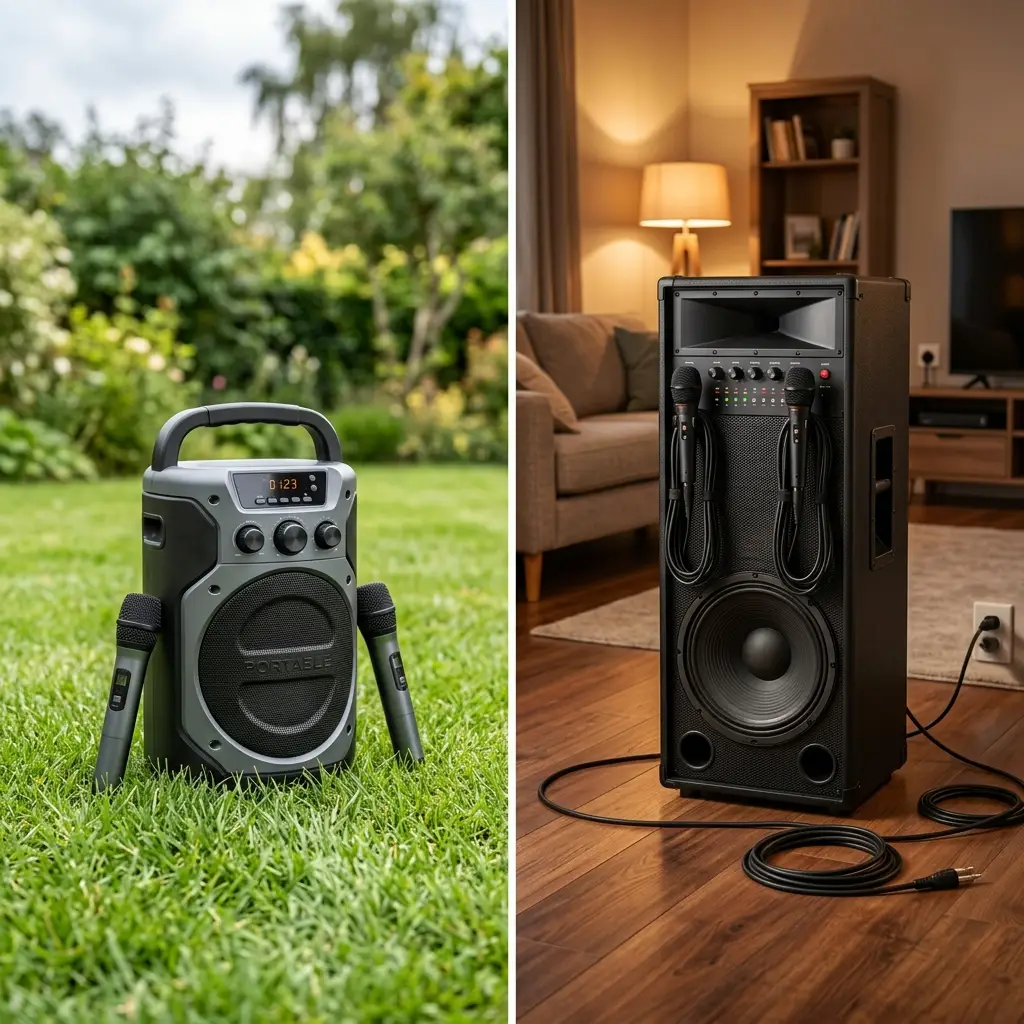
Portable and home karaoke machines differ across 5 dimensions: power source, speaker architecture, output connectivity, song access, and microphone system. Understanding these differences helps match the right machine type to the intended use case. For home setups, knowing how to connect a karaoke machine to a TV is essential — portable machines prioritise independence from external screens and mains power.
| Attribute | Portable Machine | Home System |
|---|---|---|
| Power Source | Rechargeable Li-ion battery (4–12hr) | AC mains only |
| Speaker Architecture | Compact / carry-optimised enclosure | Larger drivers (12–15”) / acoustic wood cabinet |
| Output Connectivity | AUX 3.5mm / Bluetooth / limited HDMI | HDMI + RCA to TV for full lyrics display |
| Song Access | Bluetooth stream / USB drive / built-in library | WiFi subscription / large built-in library / CD |
| Microphone System | UHF wireless / 2.4GHz BT mic | Wired XLR / professional UHF with rack receiver |
Frequently Asked Questions
What is the difference between a portable and a mini karaoke machine?
A portable karaoke machine operates on battery power for outdoor and mobile use, with speaker outputs of 10W–80W and run times of 4–12 hours. A mini karaoke machine is compact by form factor (under 5 lbs, desk-top profile) but is typically mains-powered and designed for indoor use in small rooms. The 3 defining differences are power source, intended environment, and speaker output level.
How many watts does a portable karaoke machine need for outdoor use?
A minimum of 30W with an 8-inch woofer covers outdoor groups of up to 20 people at conversational-to-elevated ambient noise levels. For groups of 20–50 people or noisy outdoor environments, 50W with a 10-inch driver is the practical minimum. For events above 50 people, a transportable PA system (100W+) is the appropriate category, not a hand-portable machine.
Do portable karaoke machines work without WiFi or Bluetooth?
Yes. Portable karaoke machines with a built-in song library (100–10,000 songs) operate fully offline without WiFi or Bluetooth. Machines without a built-in library require either a connected phone (Bluetooth stream) or a USB drive with MP3+G karaoke files. The 3 machines with the largest built-in offline libraries are the JYX PA9Plus (10,000 songs), Singsation SSYS-20 (5,000 songs), and Singing Machine SML–385 (1,000 songs).
Can a portable karaoke machine connect to a TV?
Most portable karaoke machines do not include HDMI output — they output audio only via Bluetooth or 3.5mm AUX. 4 portable machines with video output include the Sonken SD40 (HDMI), JYX PA9Plus (AV composite), Magic Sing E5 (HDMI), and iKarao Shell S1 (HDMI). For machines without video output, connect via Bluetooth to a smart TV and use the TV’s karaoke app for lyric display.
What battery type do portable karaoke machines use?
All modern portable karaoke machines use rechargeable lithium-ion (Li-ion) batteries rated at 7.4V–14.8V, 2,000mAh–10,000mAh depending on unit size. Li-ion batteries reach 80% charge in 2–3 hours and full charge in 4–6 hours via the included DC adapter. Battery packs are not user-replaceable on most models and are rated for 500–800 charge cycles before capacity degrades to 80%.
Are portable karaoke machines waterproof?
The majority of portable karaoke machines carry no IP rating and are not water-resistant. 3 machines with confirmed splash resistance are the JBL PartyBox On-The-Go (IPX4), the JBL PartyBox 110 (IPX4), and the Sony MHC-V13 (IPX4). IPX4 means protection against water splashes from any direction — it does not mean submersion protection. No consumer karaoke machine is currently rated above IPX5.
How do wireless microphones pair with portable karaoke machines?
Wireless microphones pair via UHF frequency matching (600–800MHz) or 2.4GHz digital auto-pairing, depending on the system included. UHF systems require manual channel matching between transmitter and receiver. 2.4GHz systems pair automatically at startup. Both methods complete pairing in under 30 seconds. For full pairing instructions and troubleshooting, see the karaoke machine microphone setup guide.