
JBL Karaoke Machine: PartyBox Models Compared for Karaoke Use
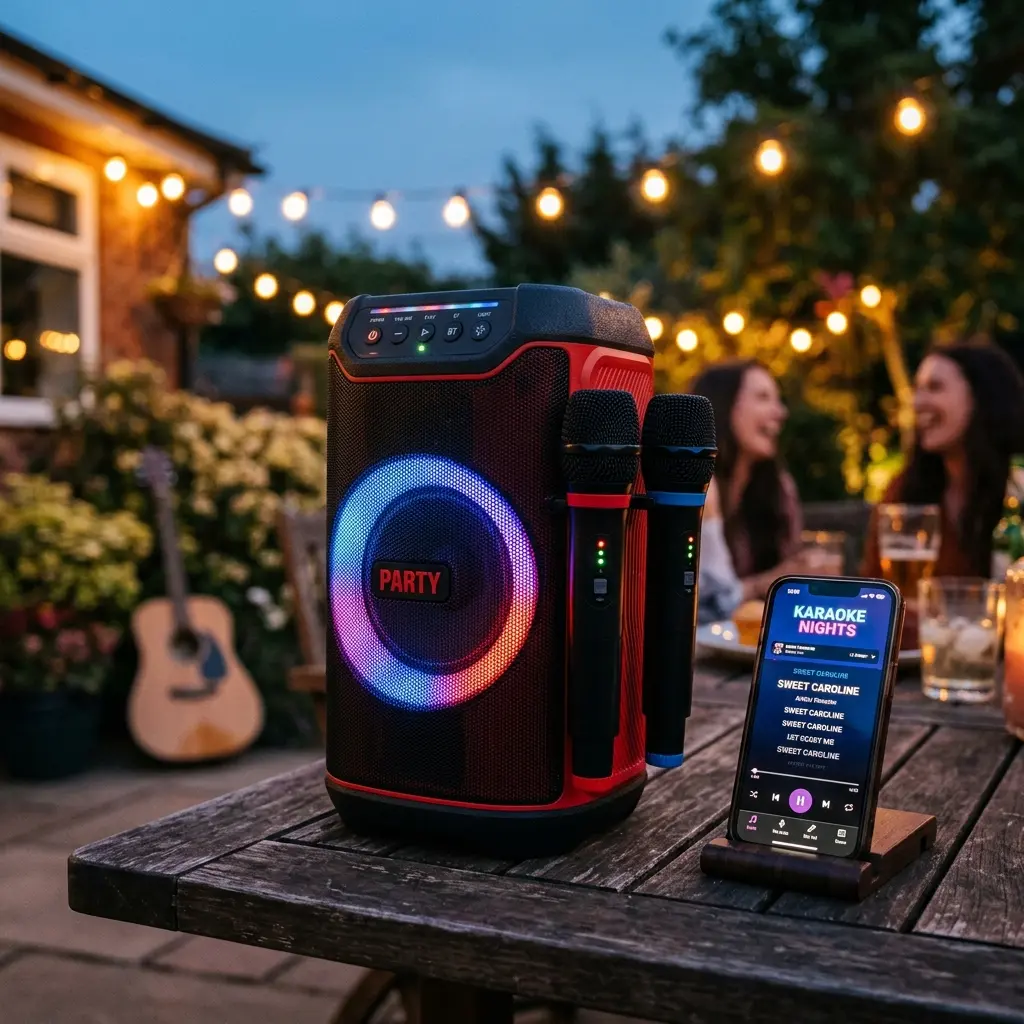
JBL Karaoke Machine is our main topic here. While many look for a dedicated jbl karaoke machine, JBL does not manufacture a standalone system. The JBL PartyBox series — 5 portable Bluetooth party speakers — includes 6.35mm microphone inputs on every model, enabling karaoke use without a dedicated karaoke system. The 5 models are the PartyBox On-The-Go, PartyBox Encore, PartyBox Encore Essential, PartyBox 110, and PartyBox 310. They differ across 4 karaoke-relevant attributes: output power (100W–240W), battery life (6–18 hours), IPX4 weather resistance (2 of 5 models), and whether microphones are included in the box (Encore only).
This page compares all 5 models for karaoke use, covers microphone compatibility, and evaluates how JBL PartyBox speakers compare to dedicated karaoke machines. For a full ranking of karaoke machines across all brands, see the best karaoke machine overall guide.
Table of Contents
- Is a JBL Karaoke Machine Setup Good for Singing?
- JBL PartyBox Models for Karaoke — Full Comparison
- JBL PartyBox On-The-Go — Best JBL for Portable Karaoke
- JBL PartyBox Encore — Best JBL for Home Karaoke
- JBL PartyBox 110 — Best JBL for Extended Outdoor Karaoke
- JBL Karaoke Machine vs Other Brands: Honest Comparison
- Microphone Compatibility for JBL PartyBox Karaoke
- Frequently Asked Questions
JBL Karaoke Machine: Is a JBL Karaoke Machine Setup Good for Singing?
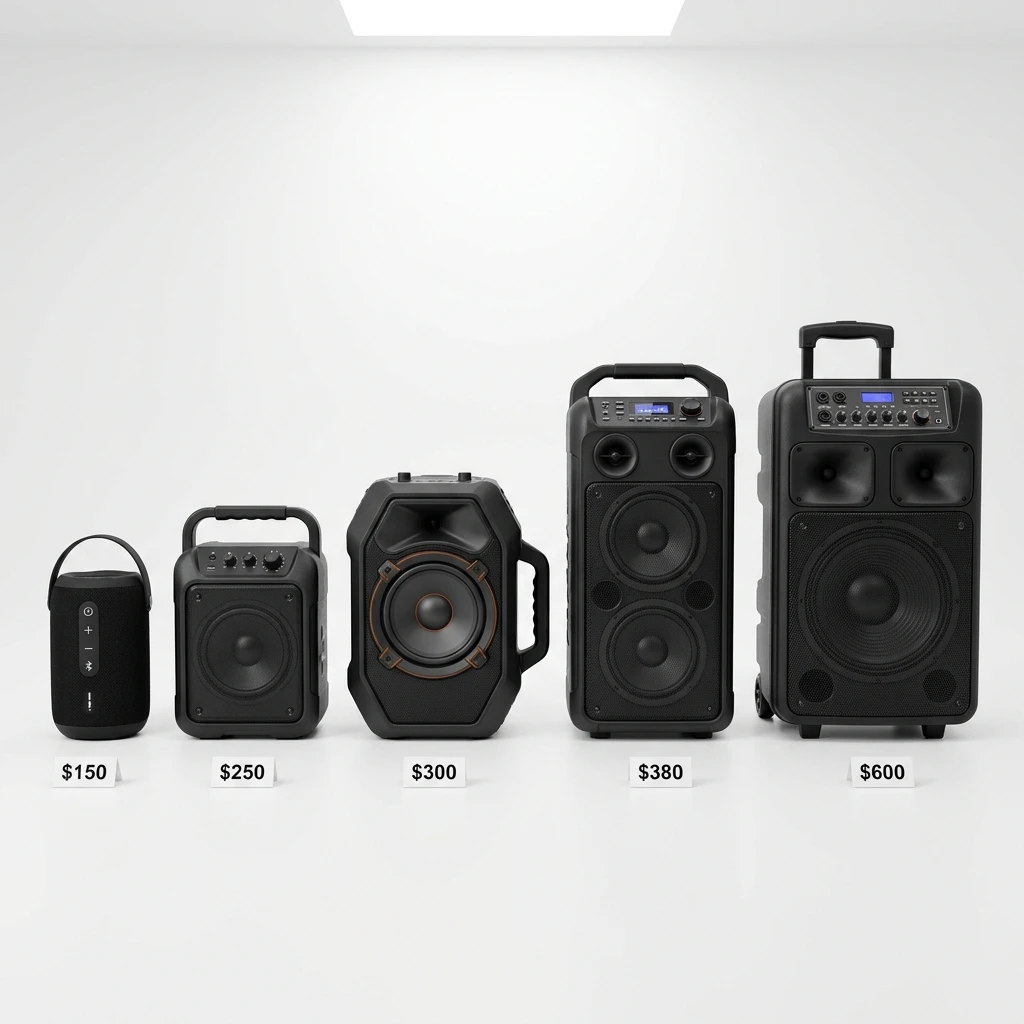
JBL PartyBox speakers are good for karaoke in the $150–$650 price range — they deliver higher audio output (100W–240W), better build quality (IPX4 on 2 models), and longer battery life (6–18 hours) than most dedicated karaoke machines at equivalent prices. The 3 advantages over dedicated karaoke machines are output power, build durability, and Harman audio engineering. The 3 limitations are the absence of a built-in song library, no integrated lyrics display screen, and no karaoke-specific vocal processing (pitch correction, key change, or harmony effects).
A buyer choosing a JBL PartyBox for karaoke connects a phone or tablet via Bluetooth, runs a karaoke app (KaraFun, YouTube, Smule), and uses the phone screen or a connected TV for lyrics. The PartyBox handles audio output only. For buyers who want a self-contained karaoke system — machine on, songs available immediately, no phone required — a dedicated karaoke machine is the correct choice. For buyers who prioritise audio quality, outdoor durability, and extended battery over karaoke-specific features, the PartyBox range is the stronger option.
JBL PartyBox Models for Karaoke — Full Comparison
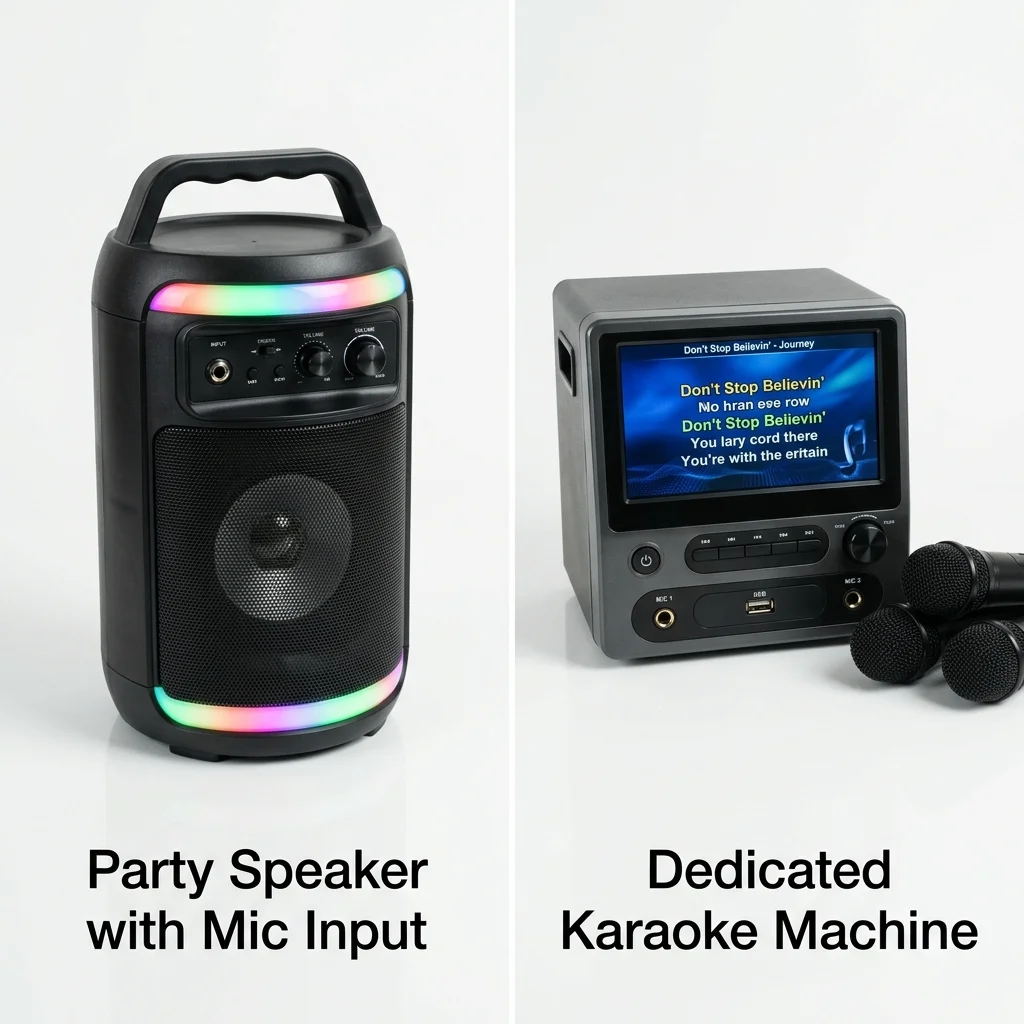
The 5 JBL PartyBox models relevant to karaoke differ across 4 key attributes: output power (100W–240W), battery life (6–18 hours), weather resistance (IPX4 on On-The-Go and 110 only), and included microphone (Encore only includes 2 wireless mics in the box).
3 purchasing decisions this table resolves immediately: the Encore is the correct choice for home karaoke buyers who want mics included; the On-The-Go and 110 are the correct choices for outdoor buyers who need splash resistance; the 310 is the correct choice for large rooms above 500 sq ft where 240W output is needed. No PartyBox model accepts XLR microphone connections — all mic inputs are 6.35mm TRS (quarter-inch jack) only.
JBL PartyBox On-The-Go — Best JBL for Portable Karaoke
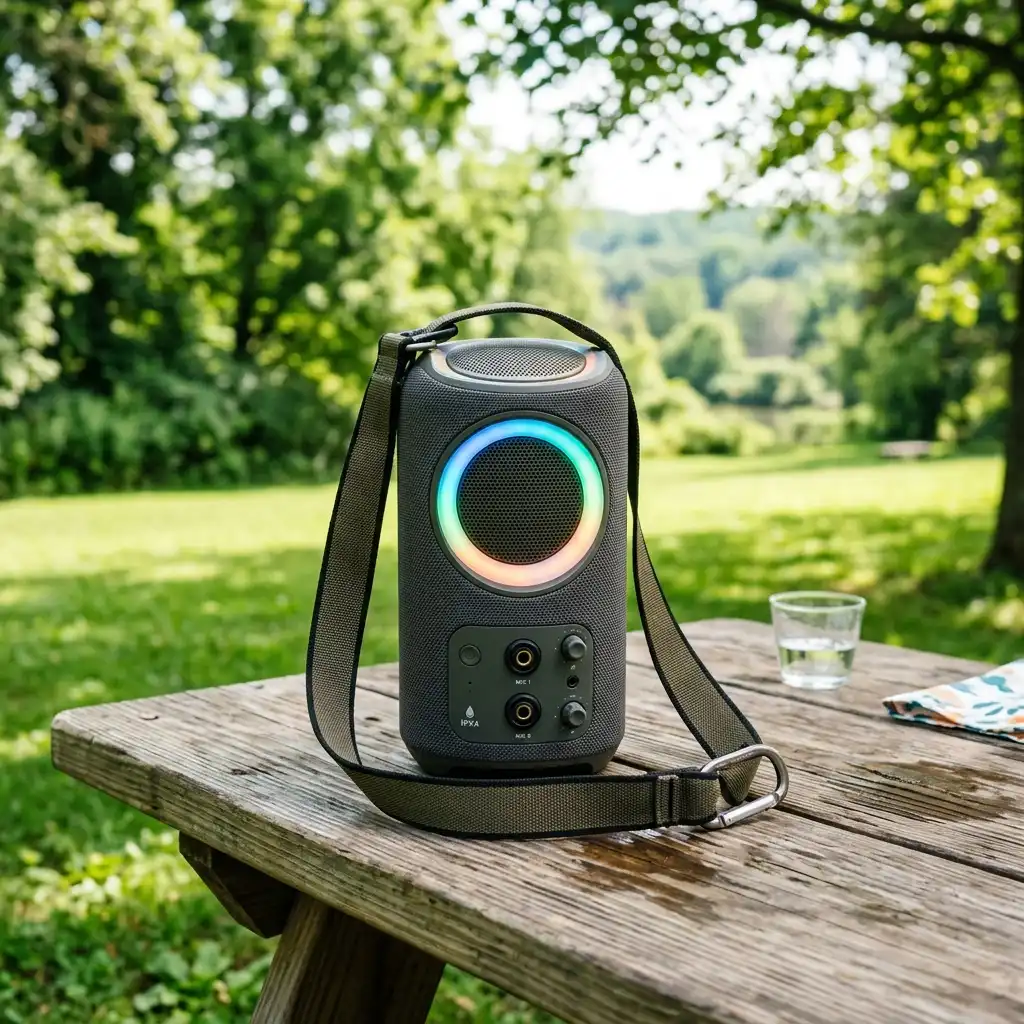
The JBL PartyBox On-The-Go is the best JBL speaker for portable outdoor karaoke — it delivers 100W output, IPX4 splash resistance, 6-hour battery, and a built-in carry strap in a 13.6 lb enclosure at $300–$350.
The On-The-Go’s 100W output drives a 3-inch tweeter and 6.5-inch woofer configuration, rated at 110dB peak SPL. At 80% volume from a 10-foot distance, the effective output level is approximately 97dB — sufficient for outdoor groups of up to 30 people in an open space. The IPX4 rating confirms protection against water splashes from any direction, covering light rain and accidental spills during outdoor events. IPX4 does not mean submersion protection.
The 2 × 6.35mm TRS mic inputs accept 2 simultaneous wired microphones, enabling duet karaoke without any additional hardware. Battery charges via USB-C to full capacity in approximately 3.5 hours. The JBL PartyBox App (iOS and Android) provides EQ adjustment and mic settings including echo depth and reverb level — these are the only karaoke-specific audio controls available, applied via the connected phone rather than a hardware panel on the unit.
Bluetooth version 5.3 delivers a measured latency of 7ms average over a 15-foot range, imperceptible when synced with lyrics on a phone screen at standard singing distance.
PartyBox On-The-Go: Karaoke Performance Summary
At 100W with 6-hour battery and IPX4, the On-The-Go covers the portable outdoor karaoke use case more capably than any dedicated portable karaoke machine at equivalent price — the trade-off is the absence of a song library, lyrics screen, and built-in karaoke vocal effects.
The DJ pad (16 touch-sensitive sample pads on the front panel) is not relevant to karaoke use. The light show (LED ring and panel) is active during karaoke use and adds visual energy at outdoor events. Carry strap rated to 30 lbs tensile load — appropriate for shoulder carry over distances of up to 500m. For portable karaoke machine alternatives with built-in song libraries, see the best portable karaoke machines guide.
JBL PartyBox Encore — Best JBL for Home Karaoke
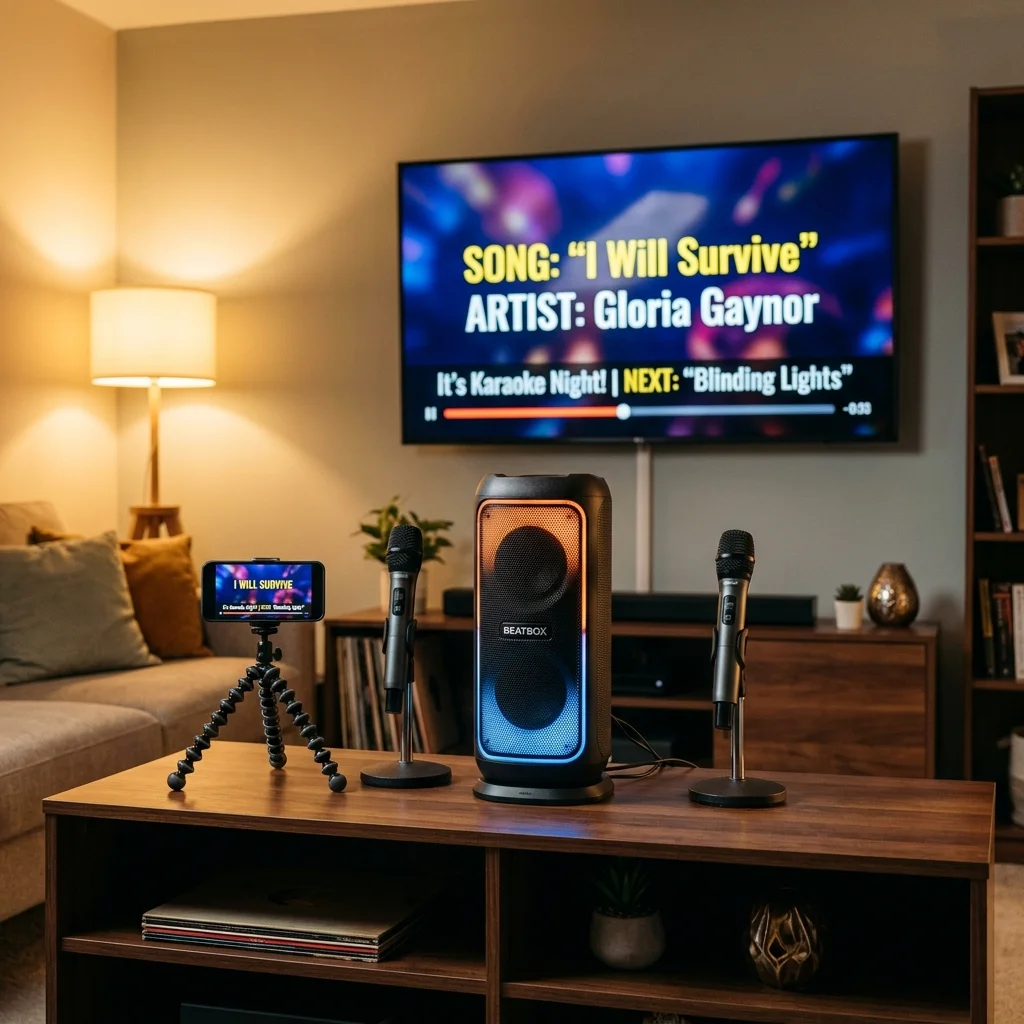
The JBL PartyBox Encore is the best JBL speaker for home karaoke — it is the only PartyBox model that includes 2 wireless UHF microphones in the box, delivering 100W output, 6-hour battery, and a complete cordless two-singer setup at $250–$300.
The Encore’s 2 included wireless microphones operate on UHF frequency with a 6.35mm receiver dongle that plugs into each mic input. The microphones auto-pair with the receiver on power-up — no manual frequency channel matching. Wireless range covers 30 feet reliably in a standard home interior. The mics charge via micro-USB; each full charge delivers 4–5 hours of continuous use.
At $250–$300, the Encore’s total cost includes 2 functional wireless microphones, 100W output, and 6-hour battery — comparable dedicated karaoke machines at this price point either include lower-quality microphones or deliver less audio output. The Encore has no IPX weather rating, making it unsuitable for outdoor use in variable conditions. It connects to a TV via Bluetooth for audio — note that Bluetooth does not transmit lyrics to a TV screen. For on-screen lyrics, a phone or tablet running a karaoke app is required at the singing position.
PartyBox Encore vs Encore Essential
The PartyBox Encore Essential ($150–$200) delivers the same 100W output and 6-hour battery as the Encore but includes a single wired microphone input and no wireless microphones — the $100 price gap between the two models pays entirely for the 2-mic UHF wireless system.
The Encore Essential is the correct choice for buyers who already own microphones and do not need cordless operation. Its single 6.35mm input limits simultaneous singers to one wired mic, making it unsuitable for duet karaoke without an external mic splitter. At $150–$200, the Encore Essential is the most affordable JBL PartyBox entry point for karaoke.
JBL PartyBox 110 — Best JBL for Extended Outdoor Karaoke
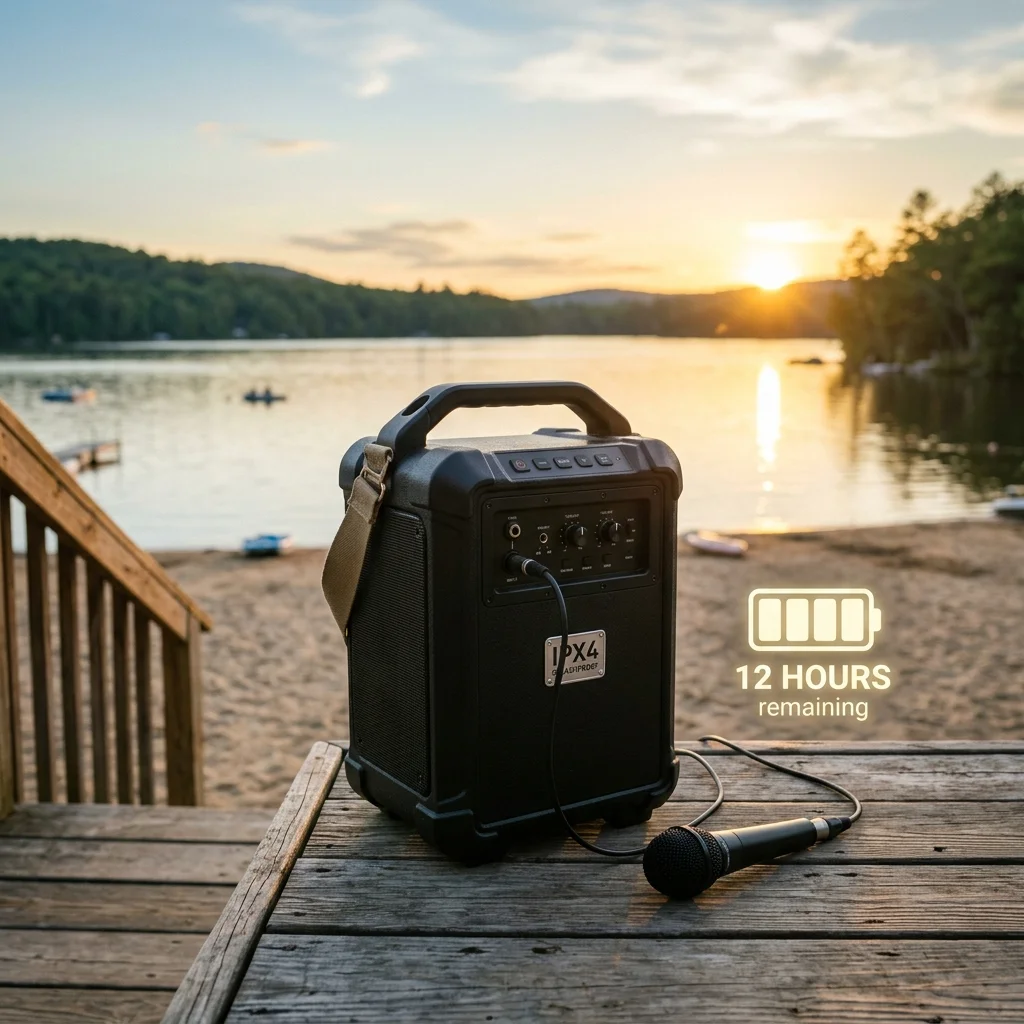
The JBL PartyBox 110 is the best JBL speaker for extended outdoor karaoke sessions — it doubles the On-The-Go’s battery life to 12 hours, increases output to 160W, maintains IPX4 weather resistance, and adds a shoulder strap carry system at $380–$420.
At 160W, the PartyBox 110 is 2dB louder than the On-The-Go at the same distance — the difference is audible but not dramatic. The practical advantage is room coverage: the 110 comfortably fills a 600–700 sq ft outdoor space at 75% volume, while the On-The-Go requires 85–90% volume for the same coverage area. The 12-hour battery at 60% volume extends across a full outdoor event day without recharging.
The 110 includes a single 6.35mm TRS mic input, limiting karaoke to one wired microphone at a time without an external splitter. Buyers who need 2 simultaneous wireless mics for the extended outdoor use case must use the On-The-Go (2 mic inputs) rather than the 110. Weight is 15.4 lbs — heavier than the On-The-Go at 13.6 lbs, with a shoulder strap and carry handle to compensate. The JBL PartyBox App supports the 110 with the same EQ, light show, and mic settings available on other PartyBox models.
JBL Karaoke Machine vs Other Brands: Honest Comparison
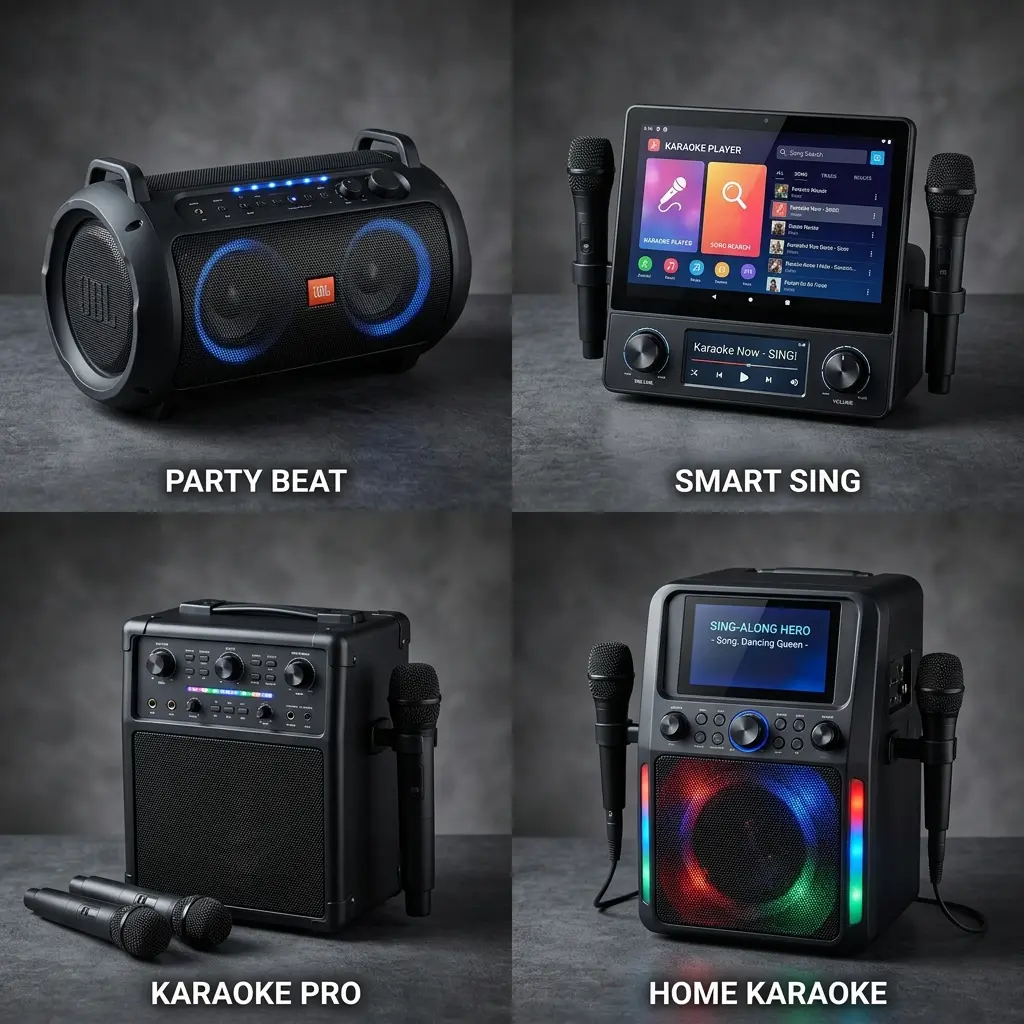
JBL PartyBox speakers outperform dedicated karaoke machines on audio output, build quality, and outdoor durability in the $150–$400 range — dedicated karaoke machines outperform JBL on 3 features: built-in song libraries, integrated lyrics screens, and karaoke-specific vocal processing.
Use-case verdict: Choose JBL PartyBox for outdoor audio quality, higher output, and IPX4 durability. Choose iKarao Shell S1 for a fully self-contained smart karaoke system with a lyrics screen. Choose JYX PA9Plus for the best value dedicated karaoke machine with a 10,000-song built-in library at $120–$160. For a full comparison of dedicated alternatives to JBL, see the JYX karaoke machine and Singing Machine karaoke brand guides.
Microphone Compatibility for JBL PartyBox Karaoke
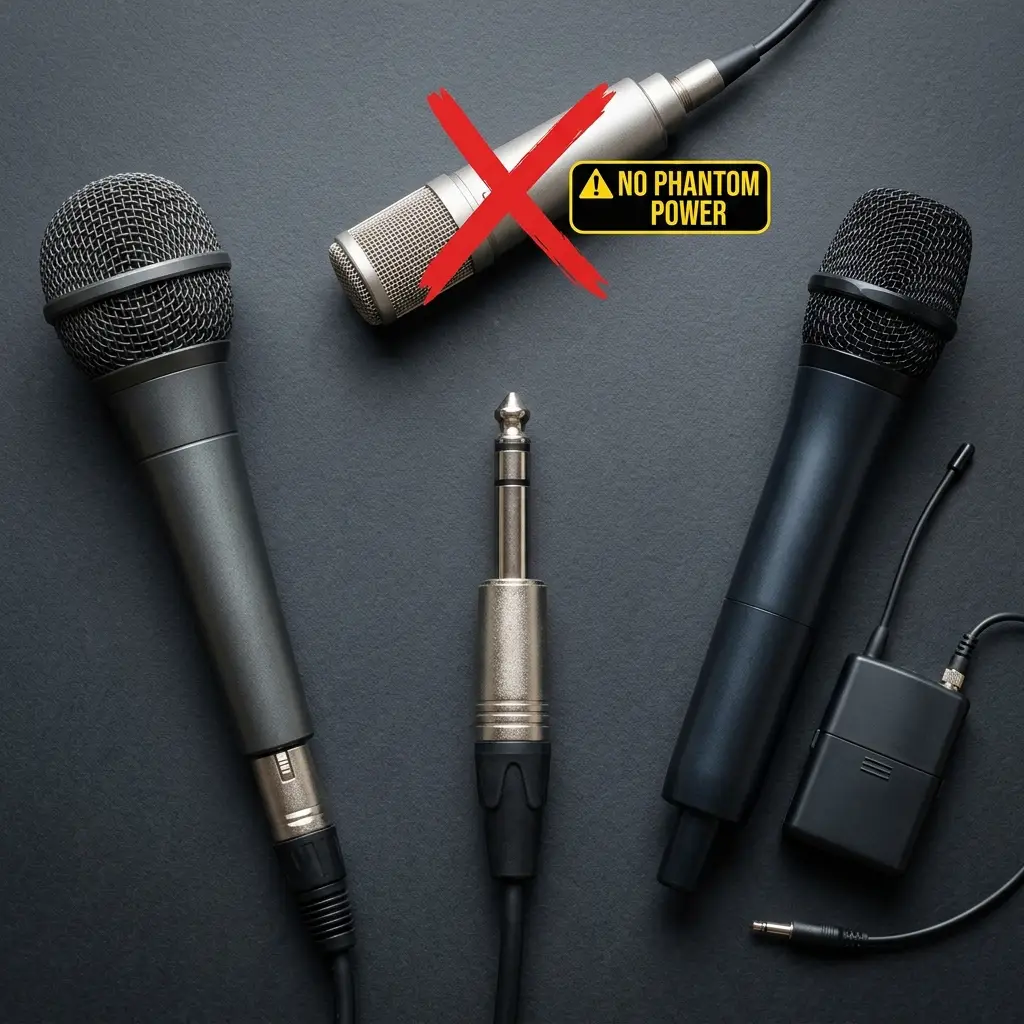
All JBL PartyBox models accept 6.35mm TRS dynamic microphones — no PartyBox model accepts XLR balanced microphones, and no PartyBox model provides +48V phantom power for condenser microphones.
The 6.35mm TRS (quarter-inch) format is the standard consumer and prosumer audio connector. Dynamic microphones using this connector — the category covering the majority of handheld vocal mics in the $20–$150 range — connect and function correctly with all PartyBox models. Two critical incompatibilities apply: XLR microphones require an XLR-to-6.35mm adapter with no performance guarantee (balanced signal converts to unbalanced through the adapter, potential interference on cable runs above 15 feet); condenser microphones requiring +48V phantom power do not function with PartyBox at all, because PartyBox mic inputs carry no phantom power supply.
The consequence of this is direct: studio condenser microphones such as the Blue Yeti, Audio-Technica AT2020, and Rode NT1 are incompatible with JBL PartyBox. These are USB or XLR condenser mics that require phantom power — neither USB nor phantom-powered XLR condenser mics work with any current PartyBox model. Buyers who own studio condensers and want to use them with JBL must route through a dedicated audio interface with phantom power between the mic and the PartyBox, adding both cost and complexity.
Recommended Microphones for JBL PartyBox
The 3 recommended microphones for JBL PartyBox karaoke are the Shure SM58 ($100, wired dynamic), the Behringer XM8500 ($25, budget wired dynamic), and the Phenyx Pro PTU-71 ($80–$100, UHF wireless with 6.35mm receiver dongle).
The Shure SM58 is a dynamic cardioid microphone with a 6.35mm output, requiring no phantom power. It is the global standard for live vocal performance and connects directly to any PartyBox mic input. The Behringer XM8500 delivers comparable cardioid dynamic performance at $25 — the lowest-cost reliable option for casual karaoke use. The Phenyx Pro PTU-71 operates on UHF 540–570MHz with a 6.35mm receiver dongle that plugs into any PartyBox mic input, delivering cordless operation at 200-foot range — the most practical wireless upgrade for PartyBox models that do not include mics (On-The-Go, 110, 310, Encore Essential).
The PartyBox Encore’s included UHF wireless mics follow the same design: receiver dongles plug into the 6.35mm inputs, the mics transmit wirelessly. The included mics are rated for 30-foot range and 4–5 hours of battery. Third-party UHF dongles with longer range (Phenyx Pro: 200 feet) are a direct upgrade path for the Encore buyer who needs extended wireless distance.
Frequently Asked Questions
Does JBL make a karaoke machine?
While many look for a dedicated jbl karaoke machine, JBL does not manufacture a standalone system. The JBL PartyBox speaker series accepts 6.35mm microphone inputs on all 5 current models, enabling karaoke use — but these are party speakers, not karaoke-specific hardware. They do not include a built-in song library, a lyrics display screen, or karaoke vocal processing. Song playback and lyrics display require a connected phone or tablet running a karaoke app such as KaraFun, Smule, or YouTube.
Which JBL speaker is best for karaoke?
The JBL PartyBox Encore is the best JBL speaker for home karaoke — it is the only PartyBox model that includes 2 wireless UHF microphones in the box, delivering a complete cordless two-singer setup at $250–$300 with 100W output and 6-hour battery. For outdoor or portable karaoke, the JBL PartyBox On-The-Go delivers IPX4 weather resistance, 100W output, and 2 mic inputs at $300–$350.
What microphones work with JBL PartyBox?
All JBL PartyBox models accept 6.35mm TRS dynamic microphones. The 3 recommended options are the Shure SM58 ($100, wired), the Behringer XM8500 ($25, budget wired), and the Phenyx Pro PTU-71 ($80–$100, UHF wireless with 6.35mm dongle). JBL PartyBox does not provide +48V phantom power — condenser microphones including Blue Yeti, AT2020, and Rode NT1 are not compatible with any PartyBox model.
Can JBL PartyBox connect to a TV for karaoke lyrics?
JBL PartyBox speakers do not output video to a TV — they are audio-only devices. For lyrics on a TV screen, connect the PartyBox via Bluetooth for audio and use the TV’s smart apps or a separate HDMI device for lyrics display. For lyrics without a TV, prop a phone or tablet near the singing position and run a karaoke app — the phone handles lyrics while the PartyBox handles audio output.
What is the difference between JBL PartyBox Encore and On-The-Go?
The Encore includes 2 wireless UHF mics but has no IPX rating, making it best for home use. The On-The-Go includes no mics but adds IPX4 splash resistance, making it best for outdoor events. Both deliver identical 100W output and 6-hour battery at similar price points ($250–$300 Encore vs $300–$350 On-The-Go). For home karaoke, the Encore’s included mics make it the stronger choice. For outdoor karaoke in variable weather, the On-The-Go’s IPX4 rating is the deciding factor.
How many microphone inputs does JBL PartyBox have?
Mic input count varies by model: On-The-Go has 2 × 6.35mm inputs; Encore has 2 × 6.35mm inputs plus 2 UHF wireless mic receivers; Encore Essential has 1 × 6.35mm input; PartyBox 110 has 1 × 6.35mm input; PartyBox 310 has 1 × 6.35mm input. No PartyBox model accepts XLR balanced connections. The On-The-Go and Encore are the only models supporting 2 simultaneous wired microphones.
Is JBL PartyBox loud enough for a party?
At 100W (On-The-Go, Encore, Encore Essential), JBL PartyBox covers indoor parties up to 500 sq ft and outdoor gatherings up to 30 people comfortably. The 160W PartyBox 110 extends indoor coverage to 700 sq ft. The 240W PartyBox 310 covers rooms up to 1,200 sq ft at standard party volume (85–90dB average). Above 1,200 sq ft or 100+ guests, a professional PA system of 500W+ is more appropriate than any single PartyBox model.
How does JBL compare to a dedicated karaoke machine?
JBL PartyBox speakers outperform dedicated karaoke machines on audio output, build durability, and outdoor capability in the $150–$400 price range. Dedicated karaoke machines outperform JBL on 3 features: built-in song libraries (no phone needed), integrated lyrics screens, and karaoke vocal processing (pitch correction, key change, harmony). For buyers prioritising audio quality and portability, JBL is the stronger choice. For buyers who want a self-contained karaoke experience with no phone dependency, a dedicated machine is correct.